

How to Measure the Accuracy of Square Linear Guides
As a reputable supplier of square linear guides, I understand the critical importance of accuracy in these components. Square linear guides are widely used in various industrial applications, from CNC machines to automated production lines. Ensuring their accuracy is essential for the overall performance and precision of the machinery they are integrated into. In this blog post, I will share some effective methods to measure the accuracy of square linear guides.
1. Straightness Measurement
Straightness is one of the most fundamental accuracy parameters of square linear guides. It refers to the degree to which the guide rail maintains a straight path along its length. To measure straightness, we can use a laser interferometer, which is a highly accurate and reliable measuring instrument.
First, mount the laser interferometer on a stable base near the linear guide. Align the laser beam with the guide rail, ensuring that it is parallel to the direction of motion. Then, move the carriage along the guide rail at a constant speed while the laser interferometer records the deviation of the carriage's position from the ideal straight line. The data collected by the interferometer can be analyzed to determine the straightness error of the guide rail.
Another method for measuring straightness is the use of a straightedge and feeler gauges. Place the straightedge on the guide rail and use feeler gauges to measure the gap between the straightedge and the rail at various points along its length. This method is relatively simple and inexpensive, but it may not provide the same level of accuracy as a laser interferometer.
2. Parallelism Measurement
Parallelism is another important accuracy parameter that ensures the smooth and stable operation of square linear guides. It refers to the degree to which the two guide rails are parallel to each other. To measure parallelism, we can use a dial indicator or a laser alignment system.
If using a dial indicator, mount it on a fixture that can be moved along one of the guide rails. Set the dial indicator to zero at a reference point on the other guide rail. Then, move the fixture along the first guide rail and record the readings of the dial indicator at regular intervals. The difference between the readings indicates the parallelism error between the two guide rails.

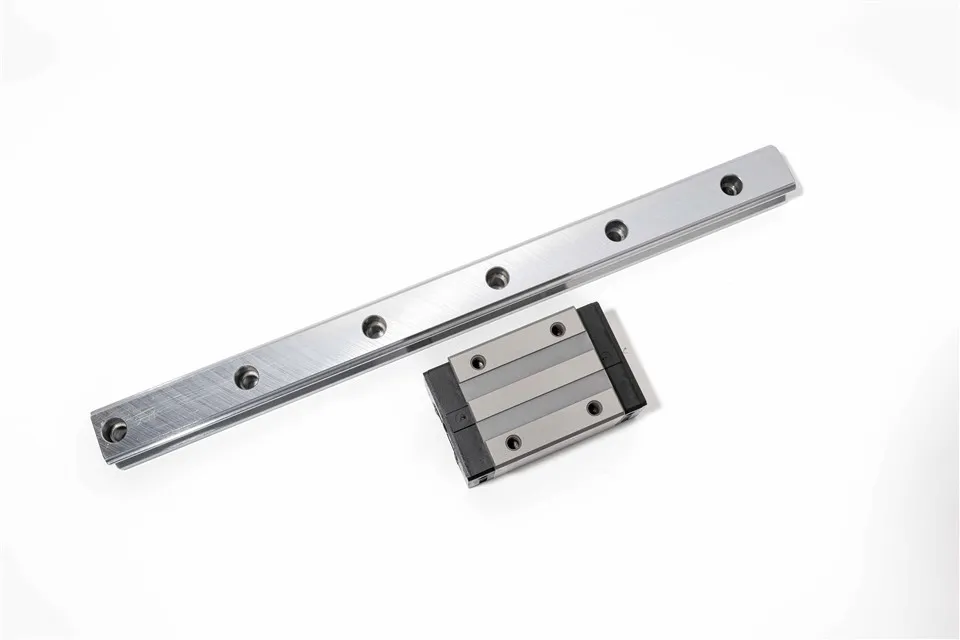
A laser alignment system provides a more advanced and accurate way to measure parallelism. It uses a laser beam to project a reference line onto the guide rails, and sensors are used to detect the position of the laser beam relative to the rails. The system can provide real-time feedback on the parallelism error and allow for precise adjustments to be made.
3. Flatness Measurement
Flatness is crucial for the proper functioning of square linear guides, as it affects the contact between the guide rail and the carriage. To measure flatness, we can use a surface plate and a dial indicator.
Place the guide rail on the surface plate and use a dial indicator to measure the height difference between different points on the rail. Move the dial indicator along the length and width of the rail, taking measurements at regular intervals. The maximum height difference indicates the flatness error of the guide rail.
In some cases, a coordinate measuring machine (CMM) can be used to measure flatness with even higher accuracy. A CMM uses a probe to measure the coordinates of points on the surface of the guide rail, and the data can be analyzed to determine the flatness error.
4. Clearance Measurement
Clearance refers to the amount of play or movement between the guide rail and the carriage. It is an important parameter that affects the precision and rigidity of the linear guide system. To measure clearance, we can use a feeler gauge or a micrometer.
Insert a feeler gauge between the guide rail and the carriage at different positions and determine the thickness of the gauge that can just fit. This thickness represents the clearance between the two components. Alternatively, a micrometer can be used to measure the distance between the guide rail and the carriage directly.
It is important to note that the clearance should be within the specified range for the particular linear guide model. Too much clearance can lead to increased vibration and reduced accuracy, while too little clearance can cause excessive friction and wear.
5. Repeatability Measurement
Repeatability is a measure of how consistently the linear guide can return to a specific position. It is an important parameter for applications that require high precision and accuracy. To measure repeatability, we can use a position sensor, such as an encoder or a linear scale.
Move the carriage to a specific position on the guide rail and record the position reading from the sensor. Then, move the carriage away from the position and back to it multiple times. Each time, record the position reading. The difference between the maximum and minimum readings indicates the repeatability error of the linear guide.
A high level of repeatability is essential for applications such as CNC machining, where precise positioning is required for each operation.
Importance of Accurate Measurement
Accurate measurement of the accuracy of square linear guides is crucial for several reasons. Firstly, it ensures the proper functioning of the machinery in which the guides are installed. Inaccurate guides can lead to increased vibration, noise, and wear, which can ultimately result in reduced performance and reliability of the equipment.
Secondly, accurate measurement allows for the early detection of any potential issues or defects in the linear guides. By identifying and addressing these problems promptly, we can prevent costly downtime and repairs.
Finally, accurate measurement is essential for maintaining high-quality standards in the production and supply of square linear guides. As a supplier, we are committed to providing our customers with products that meet or exceed their expectations in terms of accuracy and performance.
Conclusion
Measuring the accuracy of square linear guides is a complex but essential process that requires the use of appropriate measuring instruments and techniques. By ensuring the straightness, parallelism, flatness, clearance, and repeatability of the guides, we can guarantee their high performance and reliability in various industrial applications.
If you are in the market for high-quality square linear guides, we invite you to explore our product range. We offer a wide selection of HGR Linear Rail, 1200mm Linear Rail, and HG Series Linear Guideways that are designed to meet the most demanding requirements. Our team of experts is always ready to assist you with your selection and provide you with professional advice. Contact us today to start a procurement discussion and find the perfect linear guide solution for your needs.
References
- "Precision Linear Motion Technology" by John Smith
- "Industrial Automation Handbook" by David Brown
- Manufacturer's manuals and technical specifications for square linear guides